Case study · Workflow design
Visibility without interruption.
I built a Slack workflow for our agency’s event team. When a banner was ready for proofing, the designer stayed listed as its owner and the producer could see it was their turn to send the file.
01 — Origin
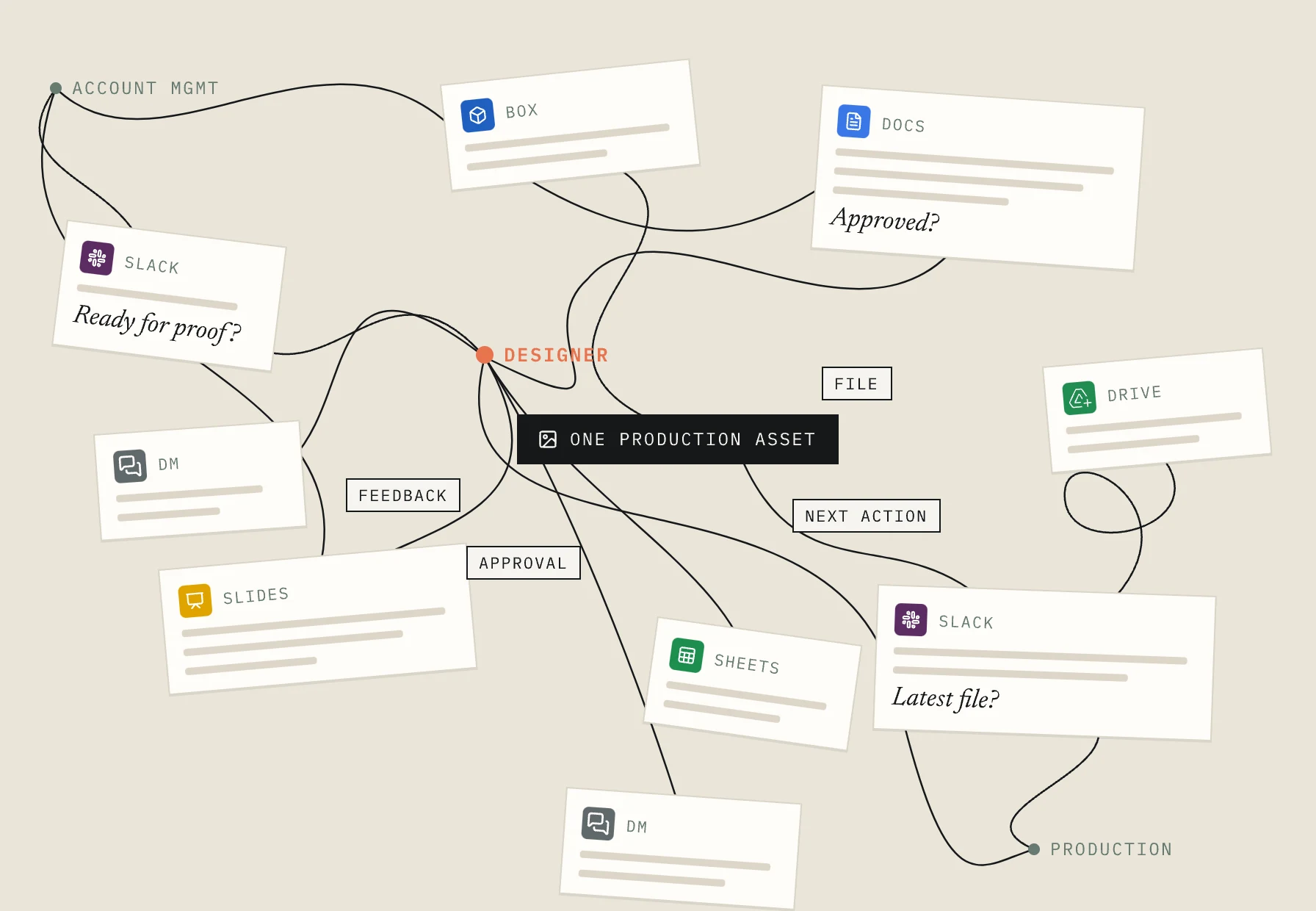
The banner is proof-ready. Who acts next?
On event projects, I worked with the account manager, client, and production designer to turn feedback into changes.
When a banner was ready for proofing, I needed to know which file we were sending, what had been approved, and who would send it. Those answers often lived in different places.
- FeedbackWhat changed?
- File referenceWhich file is current?
- ApprovalWhat has been approved?
- Next stepWhat still needs a decision?
Detail — Artifact example · Simulated data
Trade show banner
PROOF-READYOwnership and the next action are different kinds of responsibility.
In this reconstructed handoff, Maya owns the design and Sam sends the file to proof. Reassigning the banner to Sam would hide who should answer a design question. Keeping both names on the item gives the producer a clear next action and the team a route back to the designer.
People and items come from the reconstruction’s sample project.
02 — Stakes
The proof comes back wrong. Who acts next?
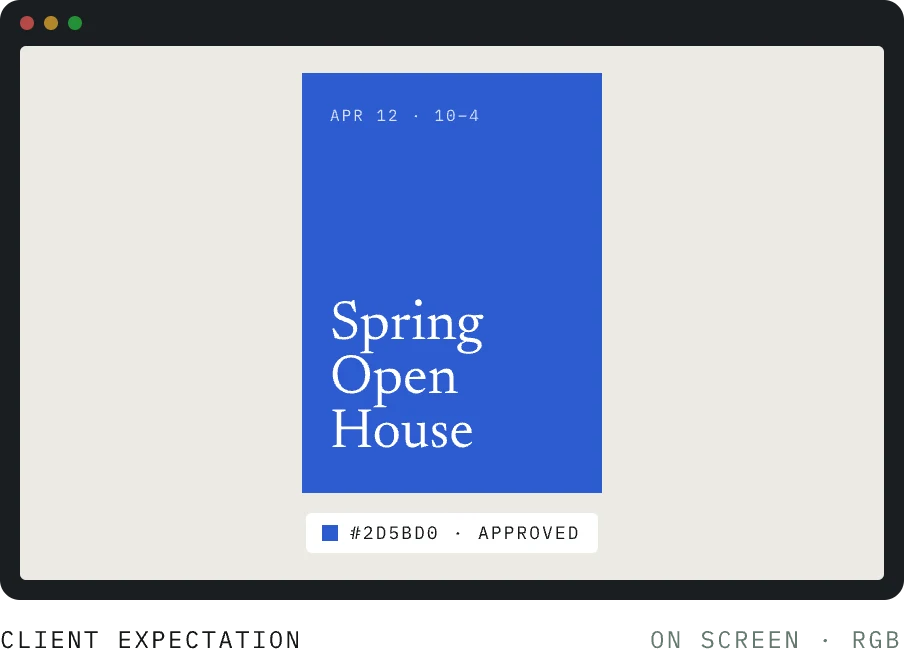
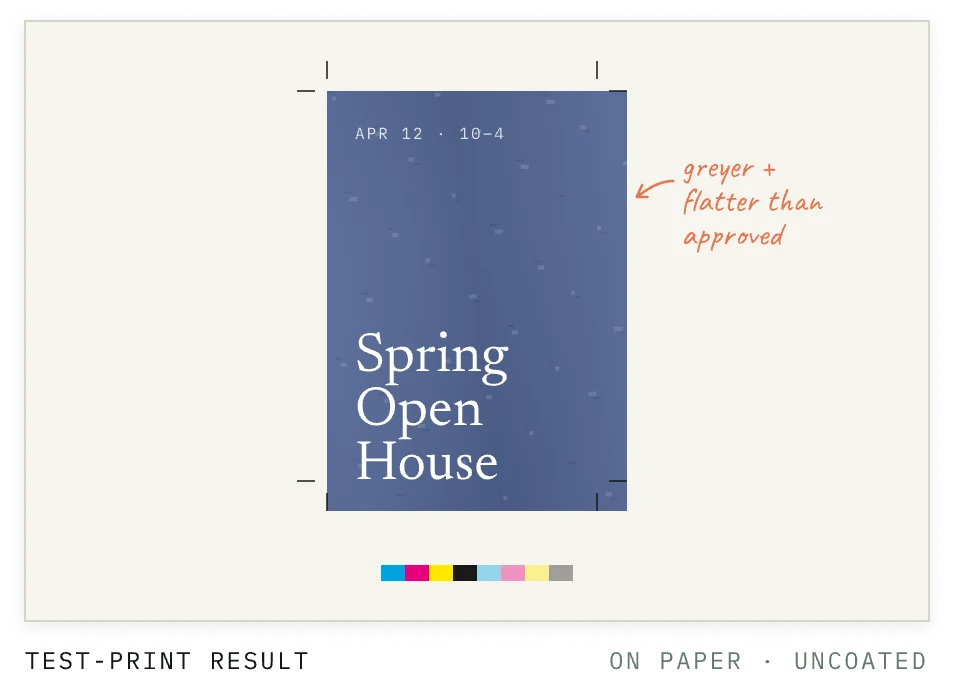
Sam sends the banner to proof. The print comes back grayer than the approved screen reference.
The banner stays at Being proofed. Maya remains the design owner, and the account lead’s next action is still to review the print.
The workflow had no stage for a failed proof, so the team handled the correction outside the tracked stages.
Detail — Artifact example · Simulated data
Trade show banner
BEING PROOFEDThe account lead was responsible for accepting the print before the team moved the banner to production.
Illustrative example · Invented banner and colors
03 — Context
Handoffs across event sessions
We used the workflow for events with multiple sessions. A trade show and an afterparty could share assets while each needed its own versions.
For each asset, the team needed to identify its owner, the latest approval and the next person to act.
| Session | A | B | C |
|---|---|---|---|
| Shared asset | |||
| Partly shared | |||
| Session-specific |
04 — Intervention
What each asset record contains
I chose Slack because the team already coordinated there. I organized each asset record around its status, owner, next action, file references and approvals.
A producer checking whether a file was ready for proofing could look up the approval on the asset.
| The coordination question | The design response | Why it matters |
|---|---|---|
| Where does this asset stand? | Shared production status | Makes progress available to people who need context. |
| Who owns it, and who acts next? | Asset ownership kept separate from the next responsible action | Responsibility can change at a handoff without erasing ownership. |
| Is this ready to move forward? | Explicit approval checkpoints | Makes clearance a deliberate decision rather than an inference from conversation. |
| Where is the supporting context? | Handoff notes and file references kept with the asset | Reduces the need to reconstruct context across unrelated conversations. |
| What do I need to focus on? | Views for different responsibilities | Lets people approach shared information through their immediate task. |
Design reasoning, not measured results.
05 — Workflow
How responsibility changes at each stage
The reconstruction shows five production stages. At each stage it displays the asset owner, the next action and the relevant clearance.
Status
In design
CLEARED FOR PROOFINGOwnerfinish design
Proof-ready
Producersend to proof
Being proofed
CLEARED FOR PRODUCTIONAccount leadapprove the proof
In production
Producerdeliver
Delivered
Nothing left to hand off
06 — Demonstration
See the handoff in context.
This interactive reconstruction, created with Claude, demonstrates the workflow I originally implemented in Slack.
07 — The result
How the team used the workflow
I implemented the workflow in Slack, and our team used it to track asset status, responsibilities and approval checkpoints during event production.
I did not measure time saved or changes in message volume.
Delivered
Slack workflow
Status, responsibilities and approval checkpoints for each production asset.
Designed to
Clearer handoffs
Make coordination clearer and reduce unnecessary back-and-forth. These are intended benefits.
Not measured
—
Time saved and message volume weren’t measured, so they aren’t claimed.
08 — Reflection
When we used a simpler handoff
For a project with one or two assets, we considered whether anyone needed to track a handoff across roles.
Principle
Number of handoffs
I would use the shared record when several people need the current file and approval. For a single exchange between a designer and a producer, a direct handoff may be sufficient.